

decide game:
QUANTUM TECHNOLOGIES
Group 5 – Participant 6
Story cards
Read all the cards from this category, choose the one that looks more interesting to you and explain it to the rest of the group.
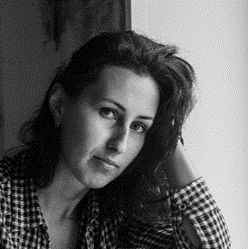
olivia ortiz
Story Card 6
I really like to go hiking, and satellite navigation systems, such as GPS and Galileo, help me not get lost.
It is amazing to be able to see my position on the map to an accuracy of just a few metres. That would be impossible if navigation systems' satellites did not have atomic clocks. The quantum nature of atoms ensures these clocks' extreme precision, which translates into a minimal margin of error on our location.

núria navas
Story Card 11
I am a physics teacher at a secondary school. I am concerned about people's lack of knowledge about scientific matters. There are more and more pseudo-scientific scams that use technical names and take advantage of misinformation and lack of critical spirit, which do nothing but take money from people. No, there is no such thing as a quantum doctor! Science is not magic.
I am trying to get my students to understand scientific concept sand analyze with a critical attitude the information they receive in their daily life.
.

dr. isidora isibarne
Story Card 17
I am a biochemist and I research new substances that could become medicines to cure diseases that are currently incurable.
One of the lengthier parts of the process of developing apossible new drug is finding out the effects it would have on organisms.
If quantum computers would become a reality for their use outside academic settings, we could significantly improve our simulation programs and this could dramatically reduce the need to experiment on living beings.
info cards
Read all cards from this category, choose the two that look more interesting and explain them to the rest of the group.

Randomness
Info Card 5
The results of a measurement are probabilistic: we have no way of knowing what will happen when we measure a single particle, but we can accurately calculate the probability of each possible result.
Applications: random numbers. In fact, this is the only way to obtain completely random numbers. Random numbers have applications in cryptography and in simulation of complex systems (weather forecast, financial market, etc.).
Quside, an ICFO spin-off, has invented a random number generator based on quantum physics.
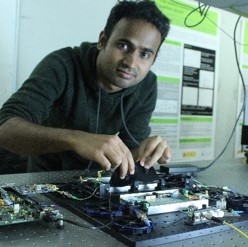
applications for Quantum Cryptography
Info Card 8
Every day we share a great deal of private information (personal, financial or health data) that could be intercepted: the cryptographic protocols that currently protect it may fail with computers more powerful than current ones.
One solution could come from quantum physics, which makes it possible to design cryptographic protocols that would resist attacks by any computer(present or future). There are still many technological challenges to integrate quantum cryptography systems into today’s telecommunications networks: solving them is the objective of QSNP, a European Quantum Flagship project coordinated by ICFO. QSNP brings together more than 40 partners, including research centres, universities, and companies, among them ICFO spin-offs such as Quside and LuxQuanta, to develop, integrate, and deploy next-generation quantum-secure communication technologies across Europe.

interferometry
Info Card 22
Interferometers are devices that use interference as a tool for very precise measurements.
Quantum properties allow us to further increase accuracy and measure things that are too small for classical physics.
Applications: gravitational waves, super-resolution microscopy, photolithography (printing materials with light), variations in the ground gravitational field (useful for knowing the levels of oil deposits or aquifers).

Laser
Info Card 33
A laser produces light through stimulated emission, a quantum process in which atoms emit photons that are identical in frequency, phase, and direction. As a result, laser light is highly directional, monochromatic, and coherent. Lasers are widely used across many fields, including fibre‑optic communications, eye surgery, industrial cutting and engraving, barcode scanners, and a wide range of scientific and technological experiments.
thinking cards
Read all the cards from this category, choose the one that looks more interesting to you and explain it to the rest of the group.

recouping investments
Thinking Card 12
Fundamental research, such as that in certain fields of quantum physics, requires economic resources that do not translate into short-term applications. On the other hand, if we limit research to sectors that can give a rapid economic return, it is difficult to reach the solid general scientific basis that underpins technological progress.
How can we solve this "vicious circle"?
The dual-use dilemma
Thinking Card 16
Quantum technologies have clear peaceful applications in medicine, communications and computing but they also have significant military potential, from breaking enemy encryption to enabling ultra-precise navigation systems that don't rely on GPS.
A scientist working on quantum sensing or cryptography may have no interest in weapons development, yet their discoveries could end up being applied in that direction. At the same time, if a country chooses not to develop these technologies on ethical grounds, it may leave itself strategically vulnerable in an increasingly competitive world.
Should scientists have a say in how their research is used, even after it leaves their hands? And is it possible or even desirable to draw a clear line between civilian and military research in a field with such broad implications?
DECISIon
The time and resources available to solve the major problems affecting society are limited. Imagine being part of the committee that has to decide how to invest money to develop quantum technologies at European level over the next few years: since you know that that quantum technologies could benefit society in many different ways, how many resources would you commit to developing them?
This is not an individual decision: each group must reach a unanimous conclusion by arguing properly and rationally based on the facts you have learned so far. There is no right or wrong answer. Like many things in life, it depends on your point of view, your priorities, etc.
quantum technologies are the future
Option 1
Their applications in all fields of human activity will radically change our lives, just as electricity and electronics once did. We must invest as much as we can in their development, to make them commercially viable as soon as possible.
quantum technologies are still too far away
Option 2
We should not be fooled by illusory promises. We have gone very far with traditional technologies and we still have a long way to go: we should keep the current investment in quantum technologies at the same level. Let scientists do their work and continue to research, focusing on maintaining and improving the technologies that we already have.
we should prioritise
Option 3
Research into quantum physics and its applications is positive, but we currently have other far more important and pressing issues, such as hunger, poverty, wars and terrorism. Let us maintain research, but invest our money to find solutions to the major problems our society has today.
we should boost basic science
Option 4
Quantum technologies are very promising, but if they are to be effective, they require solid knowledge of their foundations. We should invest in fundamental research: a better understanding of the foundations of quantum physics will naturally lead to the development of its applications.