

decide game:
QUANTUM TECHNOLOGIES
Group 4 – Participant 6
Story cards
Read all the cards from this category, choose the one that looks more interesting to you and explain it to the rest of the group.

david díaz
Story Card 1
I am a historian and a university lecturer.
I think many people put a lot of pressure on scientists to quickly turn their research into applications that benefit society. Knowledge itself is also a positive impact and it sets the bases for the innovation of the future. I think we should not demand results in form of applications so soon. We should be patient and continue to foster research.
For example, while the theoretical principles on which lasers are based were known back in 1917, it was not until the 1960s that we had the first prototype. It took many more years for it to become an essential technological tool.

clara caballero
Story Card 4
I work for a quantum information research group at ICFO, are search centre in Castelldefels, near Barcelona, although we collaborate with people from all around the world.
In addition to promoting scientific and technological research, I think it is important to tell people about how the latest scientific advances can affect their lives.
In 2016, we coordinated an international project to conduct a quantum physics experiment with the collaboration of the public. More than 100,000 people took part in the Big Bell Test!

Gerard grau
Story Card 16
I am finishing my secondary school studies and have to decide what to do in the future. I have liked science since I was young, but I do not know which subject to study in college.
I have recently been finding out about progress in the world of quantum physics. It all sounds very promising. I am excited about the idea of being able to be involved in the expansion of scientific knowledge!
In a sense, people who work in science are the explorers o modern times.
info cards
Read all cards from this category, choose the two that look more interesting and explain them to the rest of the group.

correspondence principle
Info Card 6
If everything is made up of quantum particles (atoms, etc.), how can the macroscopic world not have the same "strange" properties as quantum particles?
The correspondence principle states that the classical behaviour of macroscopic objects is the statistical result of the random behaviour of a large number of quantum particles.
We do not yet know where the boundary between quantum and classical theory lies.
Improving our perception of the world
Info Card 17
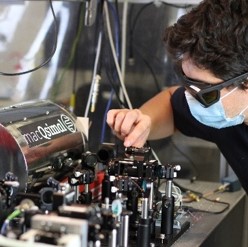
The small changes that light undergoes when it crosses materials can help us measure many features of the world around us, such as distance and temperature, with high precision.
ICFO is working to produce increasingly robust sensors capable of measuring temperature and electrical fields in extreme environments, such as during afire.
We are also researching how to build ultra-sensitive quantum sensors, for example scales that can detect the presence of a single atom with carbon nanotubes, and cold‑atom based sensors that could detect the minute magnetic fields generated by our brains, an area in which Morgan Mitchell’s group at ICFO is developing advanced atomic magnetometers for biomagnetic applications.
Photo: Prototype of an ultra-sensitive magnetic field quantum sensor.

quantum dots
Info Card 19
Quantum dots are nanoparticles that have the interesting property of emitting and absorbing specific colours of light, which can be adjusted by changing the size and composition of the dot.
Applications: macromolecular markers, microscopy, computing, improving the efficiency of photovoltaic cells and LEDs, etc.
There are already LED televisions that work with quantum dots.

Quantization
Info Card 28
In the quantum world, some physical quantities do not change smoothly but in discrete steps. A clear example is the energy of atoms: electrons can only occupy certain allowed energy levels. When an electron jumps between these levels, the atom emits or absorbs light of a specific colour. This explains atomic spectra and why different elements emit different colours. Quantization is essential for technologies such as lasers, LEDs and atomic clocks.
thinking cards
Read all the cards from this category, choose the one that looks more interesting to you and explain it to the rest of the group.

Great potential
Thinking Card 4
Although quantum technologies are still in a very early stage, their applications in very wide range of areas are enormously promising. Thomas J. Watson, the CEO of IBM, apparently said in 1943 that "there is a market for about 5 computers" in the world.
It is possible for us, at the present moment, to judge the possible impact of new technologies?
The language of uncertainity
Thinking Card 18
Quantum physics is full of concepts that are difficult to communicate to the public: superposition, entanglement, wave-particle duality. These ideas are frequently misused in advertising, popular culture or pseudoscience.
Does it matter if people misunderstand quantum physics, as long as they are generally supportive of research funding? Or does scientific literacy have a deeper value for society and if so, whose responsibility is it to promote it?
DECISIon
The time and resources available to solve the major problems affecting society are limited. Imagine being part of the committee that has to decide how to invest money to develop quantum technologies at European level over the next few years: since you know that that quantum technologies could benefit society in many different ways, how many resources would you commit to developing them?
This is not an individual decision: each group must reach a unanimous conclusion by arguing properly and rationally based on the facts you have learned so far. There is no right or wrong answer. Like many things in life, it depends on your point of view, your priorities, etc.
quantum technologies are the future
Option 1
Their applications in all fields of human activity will radically change our lives, just as electricity and electronics once did. We must invest as much as we can in their development, to make them commercially viable as soon as possible.
quantum technologies are still too far away
Option 2
We should not be fooled by illusory promises. We have gone very far with traditional technologies and we still have a long way to go: we should keep the current investment in quantum technologies at the same level. Let scientists do their work and continue to research, focusing on maintaining and improving the technologies that we already have.
we should prioritise
Option 3
Research into quantum physics and its applications is positive, but we currently have other far more important and pressing issues, such as hunger, poverty, wars and terrorism. Let us maintain research, but invest our money to find solutions to the major problems our society has today.
we should boost basic science
Option 4
Quantum technologies are very promising, but if they are to be effective, they require solid knowledge of their foundations. We should invest in fundamental research: a better understanding of the foundations of quantum physics will naturally lead to the development of its applications.